One Architecture, Two Physics Domains
The same neural network architecture — a physics-informed neural network (PINN) that enforces governing PDEs through its loss function — was applied to two distinct physical domains: fluid mechanics (CFD flow) and solid mechanics (hyperelastic material deformation). In both cases, the network learns to satisfy physical laws directly from data, without relying on a traditional finite element solver at inference time.
This research lives at the Humphrey MechanoBiology Lab at Yale, where the broader goal is developing neural surrogate models that can replace expensive COMSOL and ABAQUS simulations for continuum mechanics problems. GPU-accelerated training on NVIDIA L4 and A100 hardware enables rapid iteration over large simulation datasets generated by the CFD pipeline.
CFD Pipeline for Flow Around a Cylinder
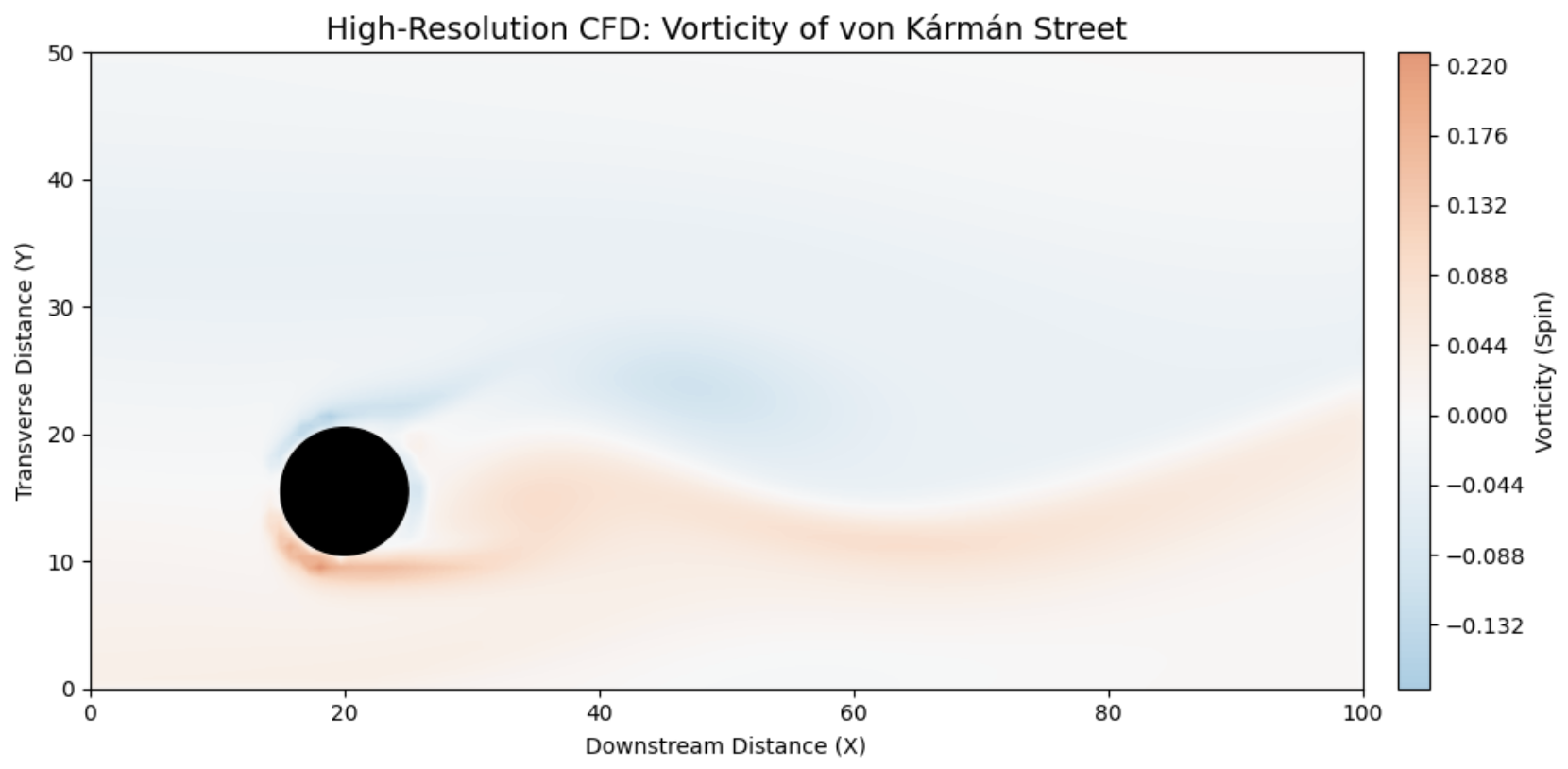
To generate ground-truth training data for the fluid mechanics PINN, I built a Python-based CFD simulation of incompressible viscous flow around a circular cylinder — a canonical benchmark problem for validating Navier-Stokes solvers. The simulation produces velocity and pressure field data at varying Reynolds numbers, capturing steady laminar flow through to the onset of vortex shedding.
These CFD datasets are fed to the PINN, which learns to predict velocity and pressure fields by minimizing a composite loss that enforces the Navier-Stokes equations, boundary conditions, and data fidelity simultaneously. Training is accelerated using CUDA-based GPU kernels, enabling iteration over large grids and parameter sweeps that would be prohibitively slow on CPU.
// what I did
- Built a Python CFD simulation of viscous flow around a cylinder to generate labeled training datasets
- Implemented physics-based loss terms enforcing the Navier-Stokes equations via automatic differentiation
- Accelerated training with CUDA kernels on NVIDIA L4 / A100 GPUs
- Validated PINN predictions against CFD ground truth across multiple Reynolds number regimes
- Iterated on network depth, collocation point sampling, and loss weighting strategies
Constitutive Equation Discovery for Hyperelastic Materials
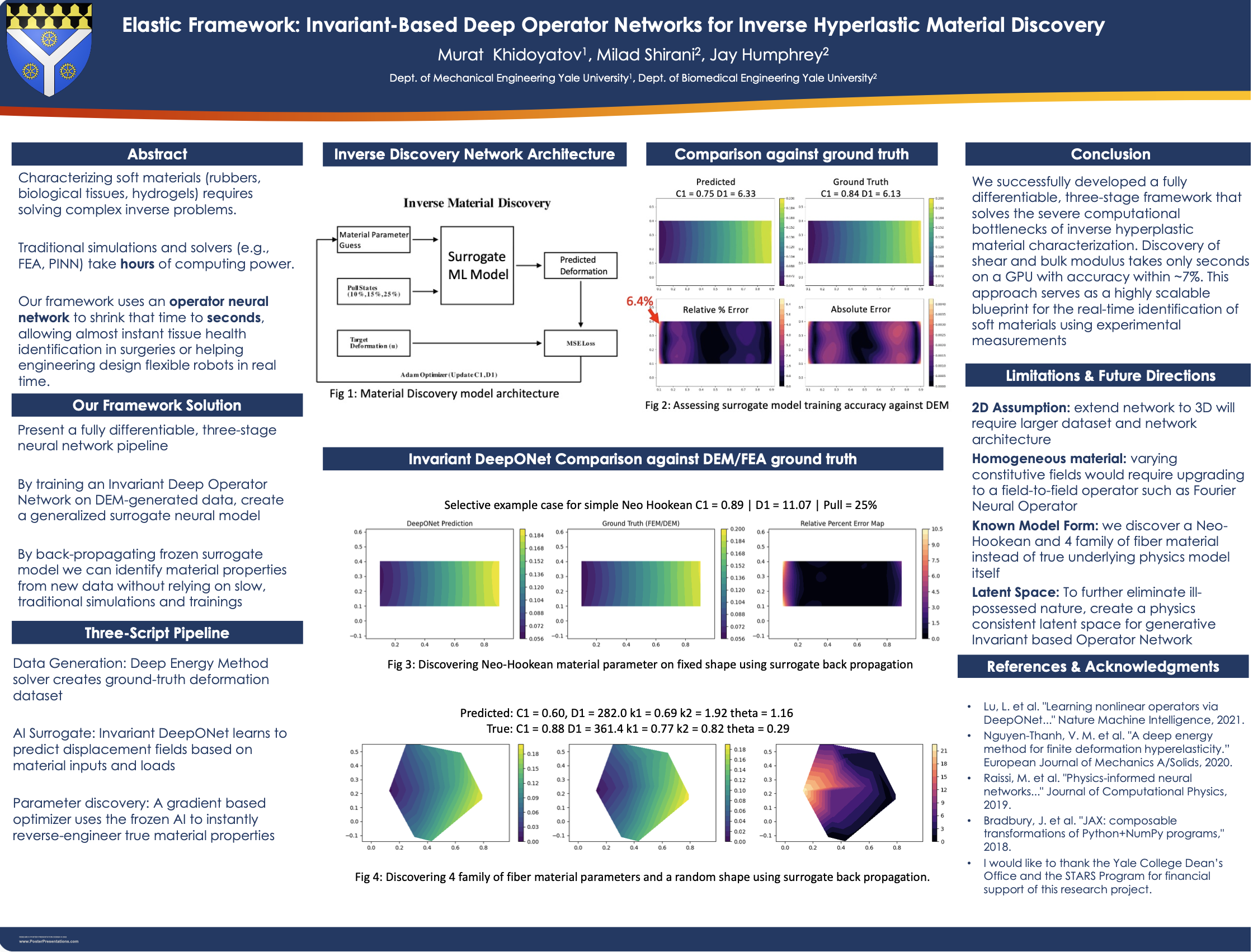
For solid mechanics, I developed a two-network architecture in JAX and PyTorch to simulate elastic deformation of hyperelastic materials and discover their underlying constitutive relationships directly from deformation data. One network predicts the displacement field; the other learns the stress-strain energy function — together replacing what would otherwise require a full finite element solve.
The framework integrates classical continuum mechanics with machine learning: physics-based loss functions enforce equilibrium equations, compatibility conditions, and material frame indifference as soft constraints during training. The system was benchmarked against COMSOL and ABAQUS simulations, achieving predictions within ±7% of FEA results on Neo-Hookean benchmark deformation problems. This work is the basis of a paper currently pending submission.
// what I did
- Architected a dual-network system: one network for displacement fields, one for the learned energy function
- Implemented physics-based loss functions enforcing equilibrium equations and material frame indifference
- Benchmarked predictions against COMSOL and ABAQUS FEA simulations
- Achieved ±7% accuracy relative to finite element solutions on Neo-Hookean deformation problems
- Analyzed error sources and tuned hyperparameters, network depth, and loss term weighting
- Validated learned constitutive equations against traditional Neo-Hookean and Mooney-Rivlin models
- Contributing to a paper pending submission (Shirani, Gueldner, Khidoyatov et al., 2026)
Shirani, M., Gueldner, P. H., Khidoyatov, M., Warren, J. L., Ninno, F., & Humphrey, J. D. (2026). Physics-Consistent Neural Networks for Learning Deformation and Director Fields in Microstructured Media with Loss-Based Validation Criteria.