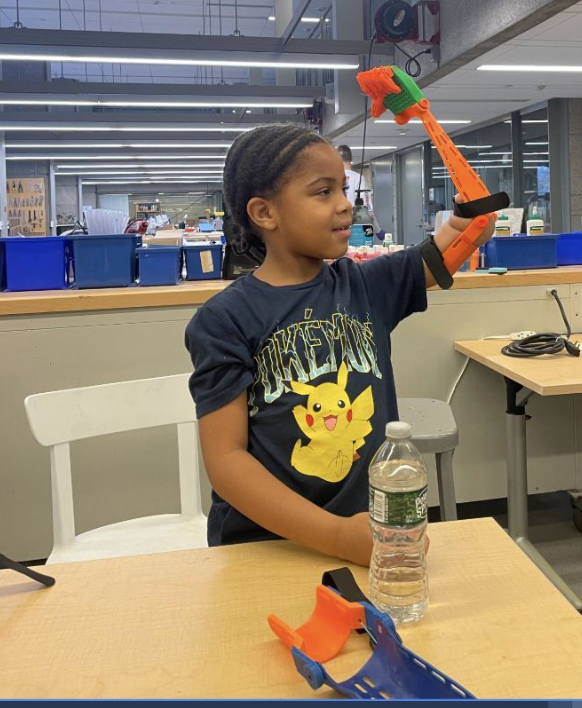
Custom Passive Arm for a Pediatric Patient
As part of Yale-AID (Assistive Independent Design), I led a seven-member multidisciplinary team to design and deliver a custom passive prosthetic arm to a 5-year-old child. The project ran in close coordination with clinicians at Yale New Haven Hospital, who helped translate the patient's mobility profile into engineering requirements.
The design centered on four constraints: lightweight construction, high durability, low manufacturing cost, and a grip mechanism simple enough for a young child to operate and remove independently. Every iteration was fit-tested with the patient and refined based on feedback from both the child and the clinical team.
Funding was secured through Yale grant programs, totaling over $5,000 to cover materials, printing runs, and clinical coordination. Root-cause analysis on early pneumatic actuator failures led to a design pivot toward a fully passive, cable- driven mechanism — more reliable, lighter, and manufacturable within budget.
// what I did
- Led a seven-member team through full design, prototyping, and patient delivery cycle
- Created CAD models for the prosthetic structure, socket interface, and wrist geometry in SolidWorks
- Used FEA to analyze stiffness, flexibility, and load-bearing performance across candidate materials
- Worked with parents and clinicians to convert patient measurements into precise engineering constraints
- Performed root-cause analysis on pneumatic actuator failures and redesigned to a passive cable-drive
- Coordinated iterative 3D-printed silicone mold designs to improve socket fit and comfort
- Managed $5,000+ project budget and delivery timeline to ensure on-time patient delivery
Engineering for Real-World Use
Pediatric prosthetics require a different design philosophy than adult devices. Children outgrow components quickly, play hard, and need devices they can put on and take off without help. This pushed every decision toward simplicity, repairability, and low-cost iteration — qualities that align well with FDM 3D printing and modular socket design.
The final device used a body-powered passive grip mechanism, a custom-fitted thermoplastic socket, and colorful PLA structural parts chosen by the patient. Delivering a working device to the patient and seeing it in use was one of the most meaningful outcomes of any project I've worked on.