ML & Bayesian Optimization for Al-Si Alloys
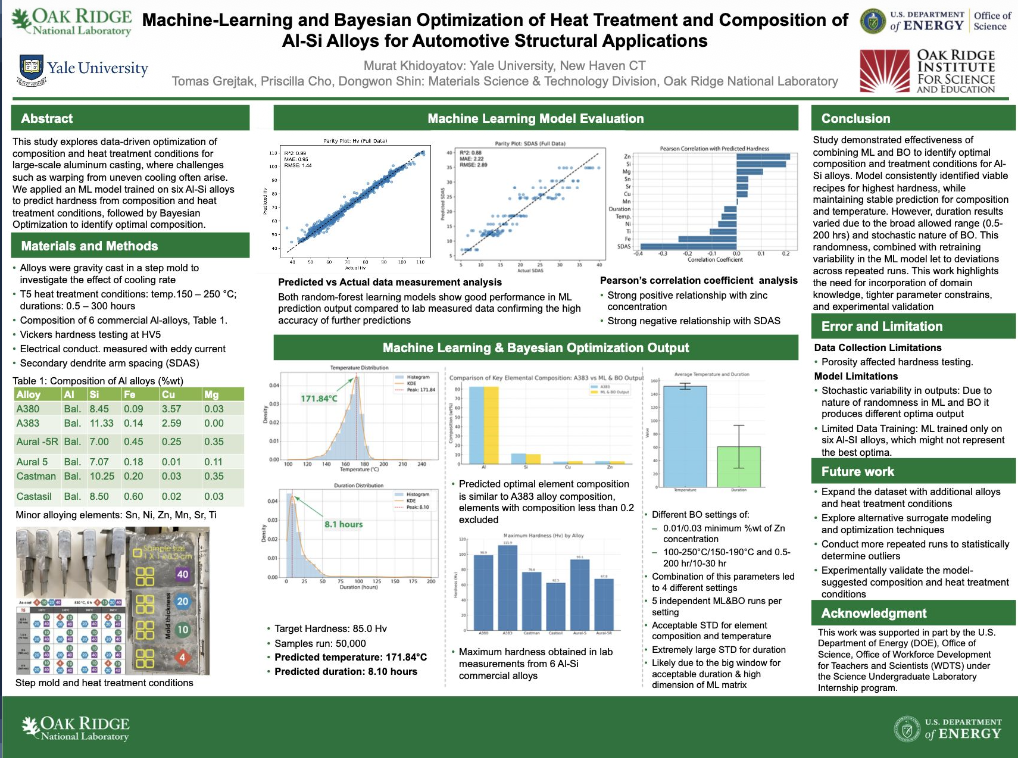
At Oak Ridge National Laboratory, I developed a machine learning and Bayesian Optimization pipeline to predict and optimize heat-treatment conditions and alloy composition for Al-Si automotive structural alloys. The target application was large-scale aluminum castings, where warping and microstructural variation from uneven cooling routinely compromise part performance.
Using experimental data from six commercial Al-Si alloys, I trained a random forest regressor to predict Vickers hardness from alloy composition, heat treatment temperature and duration, microstructural parameters, and electrical conductivity. The model achieved 96% predictive accuracy on held-out data. I then coupled this surrogate model with a Bayesian Optimization algorithm to efficiently search over 50,000 candidate processing conditions and identify optimal compositions and heat-treatment recipes.
Optimization results consistently converged toward compositions resembling the A383 commercial alloy — a physically meaningful result that validated both the model and the BO acquisition strategy. The work was presented as a research poster and is supported by the U.S. Department of Energy Office of Science under the WDTS program.
// what I did
- Built and trained a random forest regressor to predict hardness from composition, heat treatment, microstructure, and conductivity
- Developed a Bayesian Optimization pipeline to explore 50,000+ alloy and processing combinations
- Performed data cleaning, outlier filtering, and integration of experimental datasets from six commercial alloys
- Analyzed microstructure–property relationships and feature-response correlations
- Evaluated model accuracy across multiple BO settings and parameter constraint configurations
- Identified optimal composition trends that closely matched the A383 commercial alloy
- Presented findings as a research poster at ORNL
Nuclear Material Handling Tooling
In parallel with the ML work, I designed and fabricated 3D-printed tooling for graphite handling in ORNL's nuclear materials processing workflow. The existing manual process required over 12 hours per cycle due to inefficient handling fixtures and non-ergonomic tooling layouts.
Applying Design for Manufacturing principles, I redesigned the tooling around the operators' physical workflow rather than around the parts themselves. The new fixtures reduced process cycle time by 66% — from 12+ hours down to 4 hours — while improving handling safety and reducing operator fatigue. I also performed structural characterization on over 100 aluminum alloy samples as part of the broader materials research program.
// what I did
- Analyzed existing graphite handling workflow and identified bottlenecks driving 12+ hr cycle times
- Redesigned tooling fixtures using DFM principles to match operator ergonomics and reduce handling steps
- Fabricated and iterated tooling prototypes using FDM 3D printing
- Achieved a 66% reduction in process cycle time (12+ hr → 4 hr)
- Performed structural characterization on 100+ aluminum alloy samples